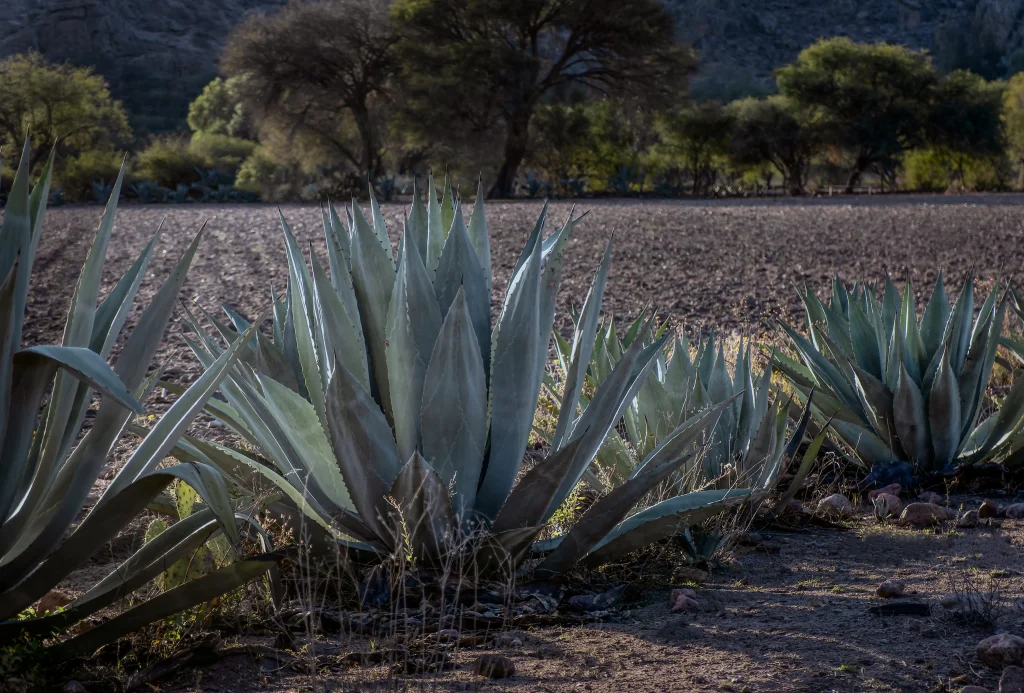
Wild or mezcal agave encompasses various agave species that grow naturally in different regions of Mexico, mainly in arid and semi-desert areas. Its importance lies in the artisanal production of mezcal, where each species contributes unique flavors, aromas, and profiles linked to the terroir and local traditions. These slow-growing, highly resilient plants are fundamental to Mexican biodiversity and culture. In addition to their use in distilled spirits, they have potential in biotechnology, natural fibers, and sustainable products, representing a resource of high ecological and economic value.
Varieties
Maguey Espadín
Rosette: 1.0–1.5 (–2.0) m tall, 1.5–2.0 m diameter.
Leaves: 40–70 per rosette, 0.6–1.0 (–1.3) m long, 4.0–5.0 (–8.0) cm wide.
Spines: Terminal spine (1.5–)2.0–3.5 cm long, 3.0–5.0 mm diameter.
Inflorescence: 2.5–3.0 (–4.0) m tall.
Flowers: JUN–AUG.
Propagation: Seeds, offsets.
Use: Used for making mezcal.
Espadín agave reaches maturity between six and nine years, depending on climate, soil, and management.
Tobalá
Rosette: 0.4-0.6 m wide and 0.5-0.7 m tall.
Leaves: 30-60(400) per plant, oval shape, wavy margins, green to whitish color.
Spines: Curved and dark.
Inflorescence: Branched, up to 4 m tall.
Flowering: AUG-NOV.
Propagation: Seed.
Use: Mostly for producing mezcal; Tobalá reaches maturity in 10 to 12 years.
Cuishe
Rosette: 0.4-0.6 m wide and 0.5-0.7 m tall.
Leaves: 30-60(400) per plant, oval shape, wavy margins, green to whitish color.
Spines: Curved and dark.
Inflorescence: Branched, up to 4 m tall.
Flowering: AUG-NOV.
Propagation: Seed.
Use: Mostly for producing mezcal; Tobalá reaches maturity in 10 to 12 years.
Madrecuishe
Rosette: 0.4-0.6 m wide and 0.5-0.7 m tall.
Leaves: 30-60(400) per plant, oval shape, wavy margins, green to whitish color.
Spines: Curved and dark.
Inflorescence: Branched, up to 4 m tall.
Flowering: AUG-NOV.
Propagation: Seed.
Use: Mostly for producing mezcal; Tobalá reaches maturity in 10 to 12 years.
Arroqueño
Rosette: 0.4-0.6 m wide and 0.5-0.7 m tall.
Leaves: 30-60(400) per plant, oval shape, wavy margins, green to whitish color.
Spines: Curved and dark.
Inflorescence: Branched, up to 4 m tall.
Flowering: AUG-NOV.
Propagation: Seed.
Use: Mostly for producing mezcal; Tobalá reaches maturity in 10 to 12 years.
Mexicano
Rosette: 0.4-0.6 m wide and 0.5-0.7 m tall.
Leaves: 30-60(400) per plant, oval shape, wavy margins, green to whitish color.
Spines: Curved and dark.
Inflorescence: Branched, up to 4 m tall.
Flowering: AUG-NOV.
Propagation: Seed.
Use: Mostly for producing mezcal; Tobalá reaches maturity in 10 to 12 years.
Agave gentryi
Agave salmiana var. gentryi is a variety of pulque agave, native to Mexico’s highlands, valued for its large size, ecological role, and traditional uses, primarily in pulque production.
Agave scabra
Agave scabra (synonym Manfreda scabra), also known as rough-leaved agave, is a member of the Agavoideae subfamily. It features rosettes reaching 0.7 to 1 meter in height (2.3–3.3 feet) and 1.5 to 2 meters in width (4.9–6.6 feet).
Its glaucous bluish-green leaves are mostly reflexed and rough (like sandpaper). The inflorescence can reach up to 4.5 meters (15 feet) tall, with yellow flowers during summer.
Agave webery
Gran agave nativo del suroeste de Estados Unidos y de México, con hojas grandes, carnosas, de color verde grisáceo, finamente dentadas y con puntas espinosas. La roseta alcanza 1.5 metros de altura y 3 metros de ancho en su madurez, con espectaculares flores amarillas ramificadas que aparecen en tallos de unos 6 metros