
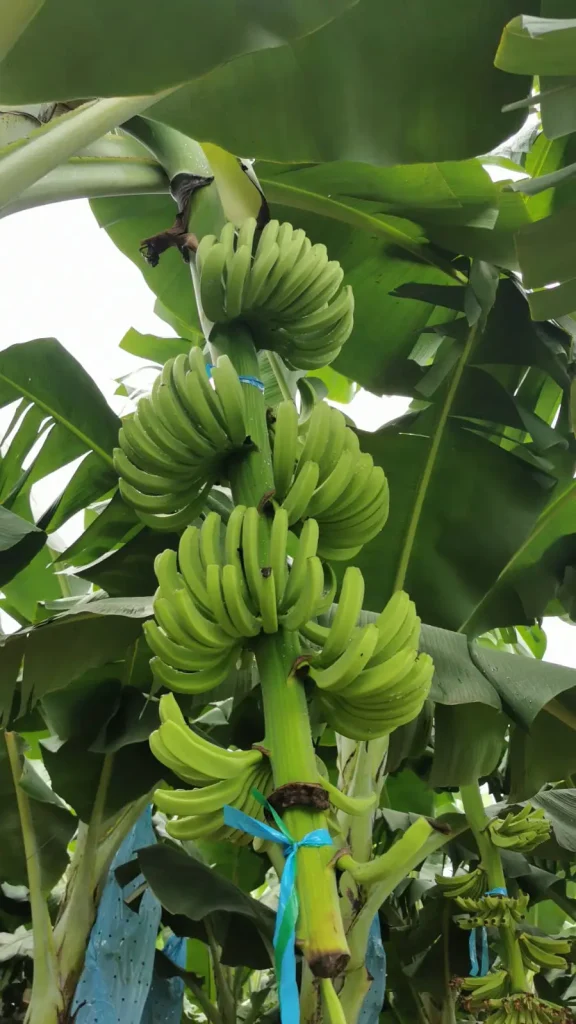
Banana
Our banana plants produced through in vitro micropropagation are disease-free and genetically uniform, ensuring reliable production and consistently high-quality fruit. Thanks to our advanced laboratory techniques, these plants deliver superior vigor, high yield, and greater resistance to common diseases, optimizing growers’ productivity.
Key Benefits:
- Disease-free varieties
- Homogeneous and reliable production
- Higher yield and fruit quality
French Banana
Adaptability
It adapts very well to most conditions.
AVAILABLE PRESENTATIONS
| Pseudostem length (m) | Fruit length (cm) | Fruit width (cm) | Bunch size (hands) | Bunch weight (Kg) | Minimum gauge | Maximum gauge | Number of fingers |
|---|---|---|---|---|---|---|---|
| 2.7 | 9.7 | 4.3 | 8 – 11 | 35 – 45 | 44 | 47 | 150 – 190 |
Williams Banana
Semi-dwarf plant with a vigorous pseudostem and extensive root system, providing greater resistance to wind lodging.
ADAPTABILITY
Greater adaptability to extreme weather, soil, and water conditions, although its main drawback is high susceptibility to nematodes and black sigatoka.
AVAILABLE PRESENTATIONS
IN VITRO:Rooted plants 4 to 6 cm, ready to adapt in greenhouse.
ADAPTED: Plants 5 to 10 cm with 0.5 cm diameter and two pairs of leaves.
HARDENED: Plants 12 to 15 cm with 0.8 cm diameter and three pairs of leaves, ready for the field
| Pseudostem length (m) | Fruit size | Bunch size (hands) | Bunch length (cm) | Bunch weight (Kg) | Minimum gauge | Maximum gauge | Fingers per hand |
|---|---|---|---|---|---|---|---|
| 3.9 | Large | 7 – 9 | 73 | 7 – 9 | 44 | 47 | 13 – 15 |
Oaxacan Banana
In vitro propagated plants are completely free of pathogens and diseases. Due to their clonal nature, they behave uniformly in the plantation and maintain high genetic fidelity.
ADAPTABILITY
It adapts very well to most conditions. Requires greater care. Resistant to nematodes.
AVAILABLE PRESENTATIONS
IN VITRO: Rooted plants 2 to 5 cm, ready to adapt in greenhouse.
ADAPTED: Plants 5 to 10 cm with 0.5 cm diameter and two pairs of leaves.
HARDENED: Plants 12 to 15 cm with 0.8 cm diameter and three pairs of leaves, ready for the field.
| Pseudostem length (m) | Fruit length (cm) | Fruit width (cm) | Bunch size (hands) | Bunch weight (Kg) | Minimum gauge | Maximum gauge | Number of fingers |
|---|---|---|---|---|---|---|---|
| 2.62 | 9.7 | 4.2 | 7 – 8 | 32 – 42 | 44 | 47 | 110 – 160 |
Chifle Plantain
In vitro propagated plants are completely free of pathogens and diseases. It is one of the four most important varieties globally. It is characterized by being early, with a low and thick stature, which makes it highly accepted for export.
ADAPTABILITY
Resistant to strong winds. Susceptible to poor management conditions such as lack of water and fertilization.
AVAILABLE PRESENTATIONS
IN VITRO: Rooted plants 2 to 5 cm, ready to adapt in greenhouse.
ADAPTED: Plants 5 to 10 cm with 0.5 cm diameter and two pairs of leaves.
HARDENED: Plants 12 to 15 cm with 0.8 cm diameter and three pairs of leaves, ready for the field.
Bamboo Banana
Plants propagated in vitro are completely free of pathogens and diseases; due to their clonal nature, they behave uniformly in the plantation and maintain high genetic fidelity.
ADAPTABILITY
It adapts very well to most conditions.
AVAILABLE PRESENTATIONS
In Vitro
Rooted plants 2 to 5 cm tall, ready for greenhouse adaptation.
Adaptadas
Plants 5 to 10 cm tall with 0.5 cm diameter and two pairs of leaves.
Endurecida
Plants 12 to 15 cm tall with 0.8 cm diameter and three pairs of leaves. Ready for field planting.
| Pseudostem length (m) | Fruit length (cm) | Fruit width (cm) | Bunch size (hands) | Bunch weight (Kg) | Minimum caliber | Maximum caliber | Number of fingers |
|---|---|---|---|---|---|---|---|
| 2.55 | 9.9 | 4.3 | 7 – 9 | 30 – 40 | 44 | 47 | 100 – 180 |
Valery Banana
Plants propagated in vitro are completely free of pathogens and diseases. This variety has a high capacity for producing offspring; despite its short height, it has a weak pseudostem that makes it susceptible to wind lodging. It is very important in Tabasco as it occupies approximately 75-80% of its surface, and it is also grown in northern Chiapas and northern Veracruz.
ADAPTABILITY
It adapts very well to most conditions. It tolerates various soil types and excess moisture. It shows resistance to Sigatoka.
AVAILABLE PRESENTATIONS
In Vitro
Rooted plants 2 to 5 cm tall, ready for greenhouse adaptation.
Adaptadas
Plants 5 to 10 cm tall with 0.5 cm diameter and two pairs of leaves.
Endurecida
Plants 12 to 15 cm tall with 0.8 cm diameter and three pairs of leaves. Ready for field planting.
| Pseudostem length (m) | Fruit length (cm) | Fruit width (cm) | Bunch size (hands) | Bunch weight (Kg) | Minimum caliber | Maximum caliber | Number of fingers |
|---|---|---|---|---|---|---|---|
| — | — | 3.6 | 7 – 12 | 18 – 23 | — | — | 160 – 200 |
Red Banana
Plants propagated in vitro are completely free of pathogens and diseases; due to their clonal nature, they behave uniformly in the plantation and maintain high genetic fidelity.
ADAPTABILITY
It adapts very well to most conditions.
AVAILABLE PRESENTATIONS
In Vitro
Rooted plants 2 to 5 cm tall, ready for greenhouse adaptation.
Adaptadas
Plants 5 to 10 cm tall with 0.5 cm diameter and two pairs of leaves.
Endurecida
Plants 12 to 15 cm tall with 0.8 cm diameter and three pairs of leaves. Ready for field planting.
| Pseudostem length (m) | Fruit length (cm) | Fruit width (cm) | Bunch size (hands) | Bunch weight (Kg) | Minimum caliber | Maximum caliber | Number of fingers |
|---|---|---|---|---|---|---|---|
| 2.63 | 9 | 4.1 | 8 – 9 | 35 – 45 | 44 | 47 | 120 – 160 |